
Unpredictable variant production. What is the real reason why demand forecasting is still necessary?
In the era of variant and variable production, accurately forecasting demand is challenging. Nevertheless, forecasting is essential because it serves a different role than before. What is its true value?
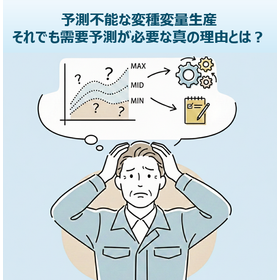
In today's world, where variant and variable production is mainstream, accurately "hitting" demand forecasts is almost impossible. There are limits to insisting on improving accuracy. Yet, why is forecasting still necessary? It is because forecasts serve as a "basis for decision-making" rather than "numbers to predict the future." For example, in response to a weather forecast of "30% chance of rain," someone who doesn't want to get wet will choose to carry an umbrella, while someone looking to reduce their load may decide not to. It is precisely because of the forecast that one can assess their risk tolerance. The same applies to production sites. Manufacturing always involves physical constraints (lead times), such as components that take months to procure or personnel arrangements that cannot be increased suddenly. It is the hypothesis of "demand is likely to increase next month" that enables "preparations in advance," such as placing advance orders or adjusting overtime shifts. Moreover, it is standard practice to capture forecasts not as points but as "ranges." Based on maximum, minimum, and intermediate forecast values, one can establish management decision-making axes, such as minimizing "waste loss" or avoiding "opportunity loss." In other words, the true value of modern demand forecasting lies not in hitting numerical targets but in providing a "basis for decision-making" in the face of an uncertain future.
- Company:テクノプロ テクノプロ・IT社 システムソリューション事業部
- Price:Other
